


Inheritance Tax (IHT) has been dominating financial headlines of late. The Treasury’s IHT receipts have risen in recent years due to frozen thresholds and with further changes announced for 2027, Britain’s “most hated tax” continues to live up to its reputation.
However, there are also some prevalent misconceptions about the tax, and taking these at face value could cost you and your family thousands.
Keep reading for a closer look at seven common IHT myths and why believing them could be so costly.
1. “Everyone leaves an IHT bill when they die”
IHT is widely seen as unfair, and a recent YouGov poll in association with law firm Kingsley Napley found that almost half (49%) of those surveyed would like it abolished. And yet, government figures confirm that in 2022/23, IHT was paid on just 4.6% of UK estates.
The main IHT threshold, the nil-rate band, is £325,000 for 2025/26, while the residence nil-rate band (which applies if you pass your main residence to a direct descendant) stands at £175,000.
This could mean the first £500,000 of your estate is effectively IHT-free. Furthermore, unused thresholds can be passed to your spouse, meaning they could have an effective IHT threshold of £1 million.
Estate and legacy planning is a key part of your finances, so understanding these thresholds could give you peace of mind, helping you to make the most of your money now.
2. “Only the wealthy pay IHT, so I don’t need to worry”
That said, it’s worth noting that the above thresholds have been frozen for some time, drawing more and more estates into the scope of IHT. This fiscal drag is set to continue, in the near future at least.
The nil-rate band has been at its current level since 2009/10. The residence nil-rate band, meanwhile, has been frozen at £175,000 since 2020/21. As the value of your property and investments has increased, so your estate will have been edging closer to these thresholds.
Government figures confirm IHT tax liabilities totalled £6.7 billion in 2022/23, a record sum at that time. The Office for Budget Responsibility (OBR) forecasts that this figure will rise to £9.1 billion for 2025/26, as more families find themselves with a liability.
3. “IHT only applies to property, so I can put my house in my children’s name”
While your property is likely to comprise a large portion of your estate, it’s important to remember that all the assets you hold will generally count towards the IHT threshold.
That’s why you need a holistic approach to estate planning that considers the whole of your finances, now and in the future.
It’s worth noting that you can’t simply gift your house to your children to remove it from your estate. Not only will the so-called “seven-year rule” apply to the gift (more on which later), but there are other factors to consider, too.
For example, if you gift your home but continue to live there (without paying market rent), this is a “gift with reservation” and your house is likely to remain part of your estate for IHT purposes.
Further complications could arise if your child has a partner from whom they subsequently get divorced. Advice around tax-efficient estate planning is crucial, so always speak to us before making any big life decisions.
4. “The seven-year taper applies to all gifts”
While you might understand the seven-year rule, the complexities of taper relief can be harder to grasp.
If you live for seven years after making a gift, it is IHT-free. Die within three years of making the gift, and IHT (if there is a liability) is payable at 40%. On death between those years, the taper applies.
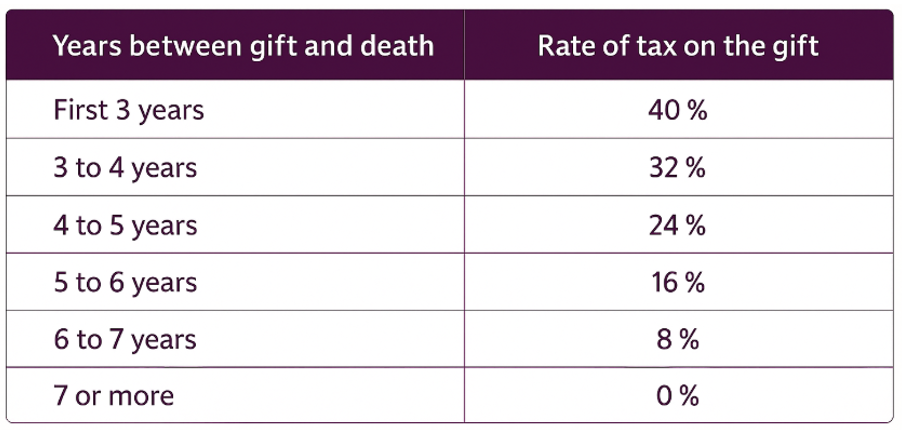
It’s important to note that this doesn’t automatically mean the IHT payable on a gift reduces if death occurs between three and seven years after making it.
So-called “failed gifts” are effectively added back into the value of your estate and will use up the nil-rate band first. Taper relief only applies to tax due on gifts exceeding the nil-rate band.
5. “My unmarried partner will automatically inherit our house when I die”
While a spouse can inherit your unused IHT thresholds, the rules for unmarried couples are different, and this can lead to problems.
If you own a house as “tenants in common” and you die without a will, the laws of intestacy apply, and you will have no say over who inherits the house. A will is therefore vital.
If your house is jointly owned and you are “joint tenants”, the property passes to the surviving partner.
6. “I don’t need a will because my partner will inherit everything”
A will is the simplest way to ensure that your wishes on death are known. Without one, your estate will be passed down according to the laws of intestacy, and this might not align with your wishes.
Once you have a will in place, be sure to check in with it regularly. Life milestones can alter your priorities, and significant events such as marriage can even void a previous will.
Bear in mind, too, that pension wealth is passed on using an expression of wish form (available from your provider) rather than through your will. Make sure it reflects your current wishes regarding who you want to benefit from your pension after you die. You’ll also need to consider changes to the IHT treatment of pensions from 2027. We can help with this if you need advice.
7. “My estate is large, but I can rely on the residence nil-rate band”
As already mentioned, the main residence nil-rate band grants you an additional £175,000 IHT-free if you pass your main home to direct descendants. Any unused portion of the allowance can be passed to your married partner, allowing them to benefit from an extra £350,000 IHT-free if you pre-decease them.
However, it’s important to note that this allowance is subject to a taper. If your estate is worth more than £2 million, the main residence nil-rate band decreases by £1 for every £2 your estate is above the £2 million threshold. An unmarried person could see their main residence nil-rate band taper to zero if their estate exceeds £2.35 million.
Get in touch
If you’re looking for an independent financial adviser in Milton Keynes or Olney, look no further. At Jane Smith Financial Planning, we’ve been helping clients for 30 years, so contact us at info@janesmithfinancial.com or call 01234 713131 to see what we can do for you.
Please note
This article is for general information only and does not constitute advice. The information is aimed at retail clients only. Please do not act based on anything you might read in this article. All contents are based on our understanding of HMRC legislation, which is subject to change.
The Financial Conduct Authority does not regulate estate planning, tax planning, or will writing.
Remember that taper relief only applies to gifts in excess of the nil-rate band. It follows that, if no tax is payable on the transfer because it does not exceed the nil-rate band (after cumulation), there can be no relief. Taper relief does not reduce the value transferred; it reduces the tax payable as a consequence of that transfer.

 Production