


One of our main roles at Jane Smith Financial Planning is to provide reassurance, especially when times are tough. We’ve shared our investment wisdom many times over the years, outlining past performance and likely future trends.
You’ll have read articles and seen graphs from us tracking the FTSE 100 index, the S&P 500, and the MSCI World Index.
But what about the “hemline index”?
Keep reading for a look at whether historic skirt length can really provide a clue to the future UK economy and what that might mean, if anything, for your investments in 2025 and beyond.
The hemline index is said to track stock market movements from the 1920s to today
The Roaring 20s to the post-war years
The 1920s signalled a moment of great optimism and jubilation in America, as the end of world war one brought economic prosperity and the arrival of the Jazz Age.
As stock markets rose, so too did hemlines – at least according to proponents of the so-called hemline index.
This suggests that hemlines throughout history can be used to track market movements. Some would go one step further, arguing that skirt length is a direct predictor of stock prices.
During the Roaring 20s, the flapper dresses of Clara Bow, Josephine Baker, and Louise Brooks (to name but a few) are said to have risen alongside markets and are, for some, an indicator of the feel-good atmosphere of this post-war period.
Immortalised in F Scott Fitzgerald’s The Great Gatsby, the hedonism of this period sadly couldn’t last.
In 1929, the Great Depression hit. Fashion shifted accordingly, the sombre mood of the nation reflected in longer skirts, which dropped to knee- or even ankle-length.
As with all indices, fluctuations occur, but skirt lengths generally remained “modest” during the 30s and 40s, with the world once again at war.
And then came Mary Quant and the swinging 60s.
The swinging 60s to today
When the post-war Baby Boomer generation came of age in the 1960s, they sparked a cultural revolution defined by modern fashion, popular music, and social upheaval.
While the Jazz Age originated in New Orleans and spread across America, with hotbeds in Chicago and New York City, the swinging 60s found its spiritual home in “Swinging London”.
It was here that fashion designers, including Mary Quant, created the miniskirt that would define the decade’s fashion and mirror its economic prosperity.
This economic boom lasted, broadly speaking, into the 1980s. The age of young, upwardly mobile professionals and the millionaire boom ended with the stock market crash of 1987.
With the crash came midi-length skirts, and then in the early 2000s, maxi dresses. But where does that leave us in 2025?
The hemline index in 2025 and beyond
The idea of the hemline index was popularised by economist George Taylor in the 1920s. While a degree of distance is often needed to see trends clearly – and the index can appear broadly applicable over large time frames – it doesn’t, of course, hold up to in-depth scrutiny.
In today’s turbulent world, many factors influence global economies. From geopolitics and conflict to the climate crisis, forecasting what will impact the economy and how isn’t easy. And while fashion might react to the prevailing mood of an era, it shouldn’t be seen as a predictor of future market movements.
That said, one trend that is worth remembering is the rise of markets over time. Here’s a Macrotrends look at historic market performance since 1914.
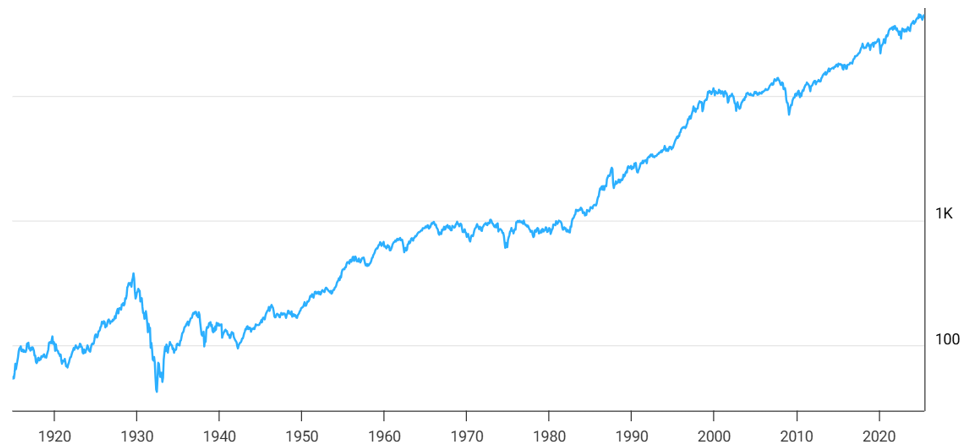
Source: Macrotrends
While you might be able to spot the rise and fall of hemlines before and immediately after the Great Depression, any other link is hard to spot. Markets fluctuate daily, but over the last 100 years, the main trend is clearly upward.
For this reason, focusing on your long-term goals, rather than the length of hemlines, is key to investment success.
While we can expect short-term volatility in 2025 and for the next few years, remember that Jane Smith is on hand to help. We have a team of professionals with experience in global markets looking after your money so that you don’t have to. Be reassured that we’ll always act in your best interest and help you to reach your goals in a risk-managed way that aligns with your values and circumstances.
Get in touch
If you’re looking for an independent financial adviser in Milton Keynes or Olney, look no further. At Jane Smith Financial Planning, we’ve been helping clients for 30 years, so contact us at info@janesmithfinancial.com or call 01234 713131 to see what we can do for you.
Please note
This article is for general information only and does not constitute advice. The information is aimed at retail clients only.
The value of your investments (and any income from them) can go down as well as up, and you may not get back the full amount you invested. Past performance is not a reliable indicator of future performance. Investments should be considered over the longer term and should fit in with your overall attitude to risk and financial circumstances.

 Production